Blogs

Is Self-Help Really Helping? The Hidden Cost of the "Fix-It" Culture
April 8, 2026

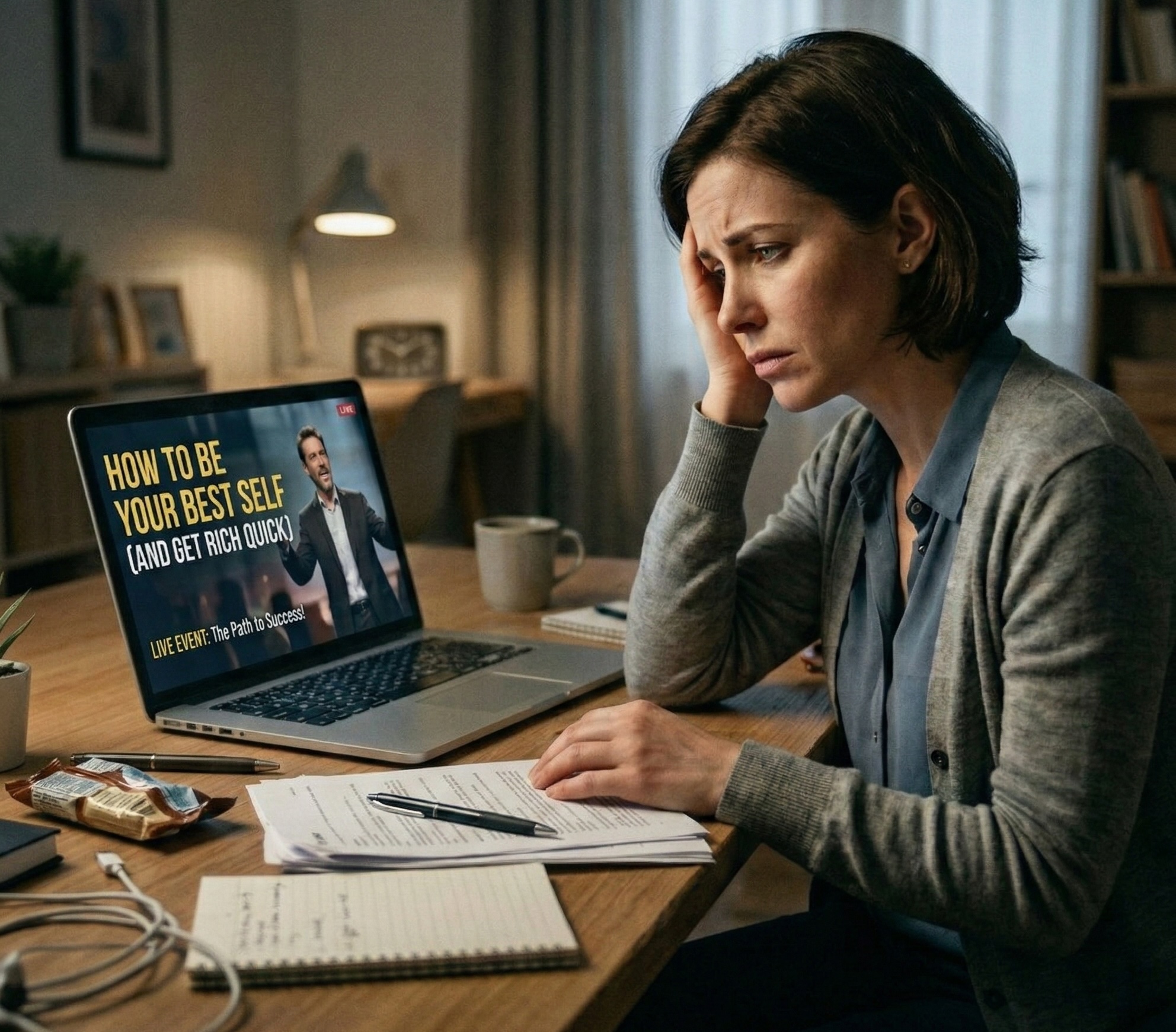
We are the most 'self-helped' generation in history. We spend billions of dollars on books, apps, and gurus promising us the secret to happiness, productivity, and resilience. Yet, by all measures, people are generally doing worse than ever - the signs are everywhere. Rates of anxiety, loneliness, and burnout continue to climb even as the self-help industry grows with no sign of slowing down. If these tools were actually the solution, wouldn't we be seeing 'better' by now?
This raises a difficult question: Is the self-help industry really helping us, or could it actually be hurting us?
The "Worst Question" at the Wrong Time
Much of modern self-help begins with a subtle, perhaps unintentional, assumption: That there is something wrong with you. It can lead us to ask a question that fuels a cycle of dissatisfaction: "What's wrong with me?" This question is a trap. It suggests you are a problem to be solved rather than a person to be understood. When we approach our lives as "projects" that need fixing, we risk becoming disconnected from who we actually are.
The Loneliness of Self-Optimization
One of the most concerning trends in self-help is the encouragement to "go it alone." We are often told to set rigid boundaries, to "protect our peace" by distancing ourselves from others, and to focus inward to find our strength.
While boundaries are important, an over-emphasis on the "self" can lead to a crisis of dislocation. By treating relationships as secondary to personal growth, we may be inadvertently fueling an epidemic of loneliness. When we are told to build a "fortress" around our well-being, we might accidentally build a prison of isolation, cutting ourselves off from the very people and resources we need to survive and to thrive.
Worse than a Waste of Time
A "waste of time" is one thing, but some self-help strategies may act as active interference in our lives. By chasing external "fixes" and pushing others away, we might unknowingly undermine our own natural architecture:
- We may lose touch with our own wisdom: By following a script written by someone who has never met us, we can stop trusting our own intuition.
- We risk alienating our most important resources: We can become "dislocated" from the relationships and environments that provide our true strength and stability.
- We trade innate strength for "lone grit": Trying to power through on our own often leads to a cycle of exhaustion and self-blame.
The Cross-Threading Trap
In my work, I often refer to this internal friction as a type of "Cross-Threading". It's that feeling of forcing your life to fit a mold that wasn't made for you. The harder you try to follow a "perfect system" in isolation, the more you might be stripping the threads of your own well-being.
True growth isn't about adopting someone else's habits; it's about learning and aligning with your own CORE 4: your unique Needs, Values, Goals, and Strengths.
Forces Without a Source
Think of your CORE 4 as the primary forces of meaning and motivation in your life. But here is the piece the industry often misses: A force requires a source.
You can't activate your CORE 4 in a vacuum. These forces are best accessed and "plugged in" within relationships and environments where you feel safe, where you matter, and where you can depend on the world around you. When we disconnect from these sources to focus solely on "self-work," we are essentially trying to light a room while unplugging from the power plant.
Resilience is a Team Sport
Unfortunately, the narrative of 'lone grit' has misled us for decades. We feel let down by self-help because it asks us to be resilient in a vacuum, ignoring the fact that human strength is, and has always been, relational.
It's so important, I must state it again - True resilience is Relational. Our potential is activated through "serve and return" - the human connection and co-regulation we get from others. When we feel we matter in our environments, our CORE 4 lights up, and the path to "better" becomes a natural flow rather than a forced effort.
Start in the Strength, Not the Stuck
It's time to stop looking for a guru and start looking at the patterns of your own life. Instead of asking what is wrong, it's time to ask the most empowering question available to us: "What is right with me?"
You don't need another person's success story to copy. You need to understand how your own unique CORE 4 have already equipped you for greatness. When you understand and tune into your own unique need, values, goals and strengths, you aren't just helping yourself; you're becoming a more powerful resource for everyone you are responsible for, from your children to your colleagues.
You don't need to get "better" alone. We get better together.
Are You Ready to Stop the Cross-Threading?
I realize the irony of offering a book in a world already drowning in self-help advice. But Getting to Better isn't a manual of "expert" tips to fix what's wrong with you. It is a way of being - a framework for understanding how your innate human strength is nurtured, developed, and fortified with and through your relationships with others.
In my work, I move past the "fix-it" mentality and introduce the CORE Algorithm. It is designed to help you stop starting from "stuck" and start from "strength." It's about decoding your unique forces of meaning and plugging them back into the relationships and environments that hold true value. We don't get better by following a guru; we get better by reconnecting our forces to the sources that make us whole
To learn more about Getting to Better and to buy your copy now, Click Here.
Stephen de Groot is President and CoFounder at Brivia. He is the author of the highly acclaimed book Getting to Better: A New Model for Elevating Human Potential at Work and in Life and Responsive Leadership (SAGE, 2016).















 November 2, 2023